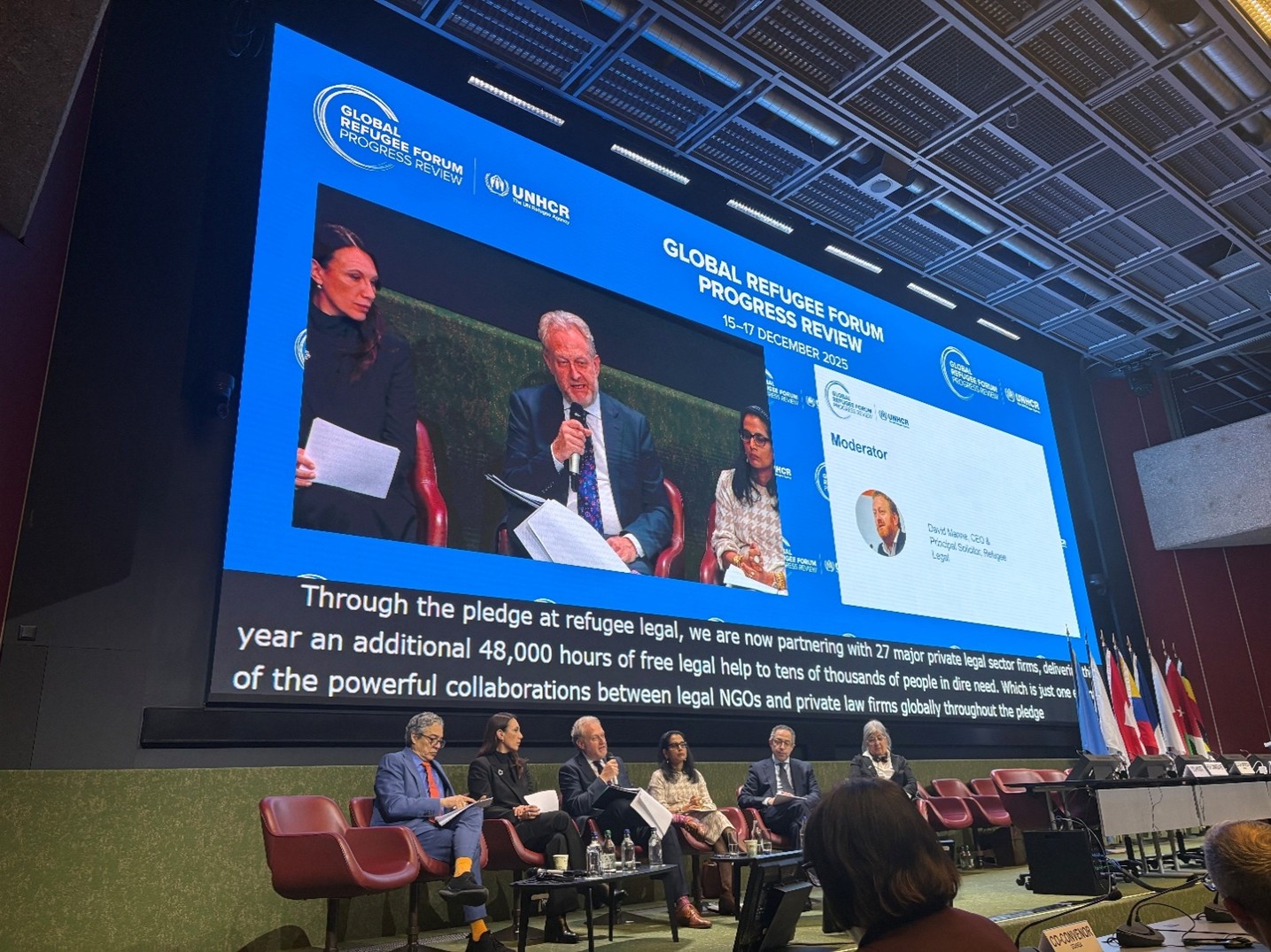
Speakers at the spotlight session ‘Strong and Sustainable Asylum Systems: Addressing Challenges, Enabling Protection and Solutions’, at the Global Refugee Forum Progress Review 2025. ©UNHCR
The Global Refugee Forum (GRF) Progress Review, the second high-level officials meeting took place from 15-17 December 2025 in Geneva, Switzerland, bringing together States and stakeholders to assess progress on GRF pledge implementation and outline next steps ahead of the GRF 2027.
A key moment at the Progress Review was the spotlight session led by the Asylum Capacity Support Group (ACSG) on ‘Strong and Sustainable Asylum Systems: Addressing Challenges, Enabling Protection and Solutions’. Bringing together governments, regional organizations, refugee-led organizations, and civil society, the session reconfirmed the importance of fair and efficient asylum systems to uphold international protection and support refugee inclusion and self-reliance even with growing backlogs and resource pressures. Calling for sustained political commitment, whole‑of‑society cooperation, and meaningful refugee participation, the discussion highlighted practical approaches including legal assistance, differentiated case processing, digital solutions, and regional cooperation for improving efficiency while safeguarding due process. The session concluded with a call for collective action to build more accessible and sustainable asylum systems ahead of the next GRF in 2027. A video recording is available for viewing.
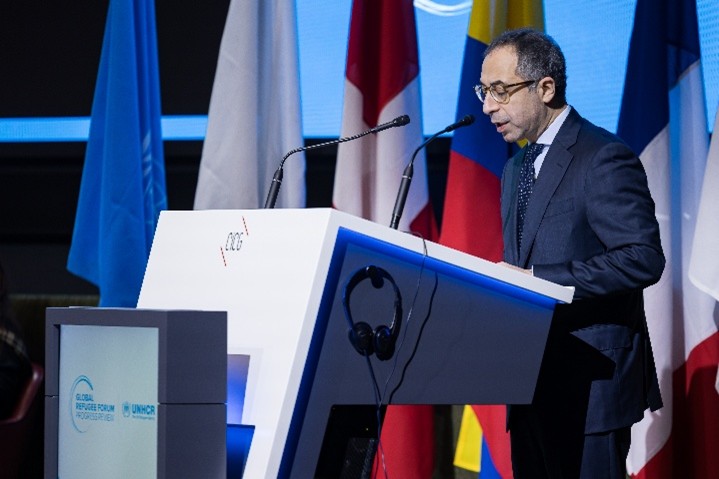
A member of the Egyptian delegation announces a new pledge on day two of the Global Refugee Forum Progress Review 2025
© UNHCR/Pierre Albouy
The Progress Review also provided an opportunity for new pledges. Egypt made a pledge to establish and operationalize a comprehensive national asylum system aligned with international standards under the new Egyptian Asylum Law No. 164 of 2024.
Further details on pledges and contributions can be found under the pledges tab of the ACSG portal.
Advancing multi-stakeholder action – key highlights
Since its establishment, the Asylum Capacity Support Group (ACSG) has mobilized 135 pledges – 74 pledges at the GRF 2019 and 61 new commitments towards the ‘Asylum Capacity – Asylum Capacity Support Group (ACSG)’ multistakeholder pledge at the GRF 2023. Today, many of those commitments are shaping tangible progress, driving initiatives that strengthen asylum systems globally.
In a challenging context in which asylum systems are responding to continued high numbers of forcibly displaced people, 31 pledges are reported as fulfilled, while 74 pledges are in progress or in planning stage based on updates provided during the regional stocktaking efforts and contributions to the GCR Digital Platform.
The ACSG Secretariat, together with UNHCR’s Regional Bureaus and Country Operations, continues to support States in turning their pledges into concrete, actionable requests and offers, resulting in nine successful matches to date. In addition to the initial seven matches, two new matches were welcomed in 2025, namely: 1) Democratic Republic of Congo/France; and 2) Canada/Costa Rica. France’s asylum authority OFPRA will support DRC’s National Commission for Refugees (CNR) to develop a national asylum strategy, enhancing case management and refugee status determination, and advising on legislative reforms. Similarly, Canada and Costa Rica have partnered to advance Costa Rica’s Asylum Modernization Strategy, focusing on enhancing procedures and operational capacity for more consistent and effective registration and adjudication of asylum claims.
Several States have reported progress in implementing their support pledges. Australia and New Zealand are advancing their pledge to enhance asylum capacity within the Asia-and the Pacific region through Refugee Status Determination training workshops, study missions, mentoring, and training. In Europe, Switzerland and Georgia are advancing their joint pledge through exploring best practices in reception procedures and migration management. Sweden hosted Iraqi officials engaged in the development of asylum legislation to showcase their asylum procedures.
Several States advanced their policy pledges on legal and policy frameworks being strengthened across regions. Botswana and Chad completed the review or adoption of legislation. Others including Burkina Faso, Lithuania, Malawi and Zimbabwe have initiated reviews or processes to update or adopt their refugee acts.
States are making notable progress in strengthening asylum procedures through institutional reforms and quality assurance. Guatemala expanded access to asylum by deploying missions to border areas while Colombia is introducing procedural and institutional structural adjustments. Uruguay established a Reference Centre for Migrants in Montevideo to provide integrated services.
Many states are strengthening their procedures through differentiated processing, digitization and improved case management. In the Americas, Belize granted legal status and permanent residence to asylum-seekers through an amnesty exercise, while Brazil applied simplified procedures under the Cartagena definition for certain nationalities. Mexico modernized and digitalized its asylum process, streamlined eligibility processes, developed country‑of‑origin support packages, and introduced biometric systems to boost adjudication capacity and reduce backlogs. El Salvador advanced system design through a consultancy, and Peru and Costa Rica cleared large numbers of inactive cases with safeguards. In Europe, Armenia introduced a digital case management system to streamline processing. In Africa, Chad processed nearly half of its pending RSD cases and partnered with OFPRA (France) to train eligibility officers, digitalize procedures, while also approving a draft decree on legal aid.
Reinforcing resource management practices and building skilled and sustainable asylum workforces is key to improving decision-making and avoiding poorly reasoned decisions. Guatemala, through the improvement of interviewing techniques and the use of country-of-origin information, was able to increase its processing capacity from 30 to 75 technical reports per month. North Macedonia also took steps towards training and capacity-development for its asylum officers to improve quality of its procedures.
Finally, states made progress in improving asylum-seekers’ access to information and legal assistance, ensuring their meaningful participation in national asylum procedures. The most notable achievements are reported by the signatories to the Global Legal Community Pledge, coordinated by PILnet. Collectively, these signatories delivered 393,182 hours of free legal assistance, exceeding their pledged commitment of 264,648 hours by nearly 50%, expanding refugees’ access to critical legal services and information.
Global and regional pledges
At the GRF 2023, regional organizations and platforms, and states collectively made regional commitments to harmonize refugee laws and policies, as well as enhancing asylum systems along key migratory routes.
In the Americas, the Comprehensive Regional Protection and Solutions Framework (MIRPS) advanced its pledges through new guidance on child‑sensitive procedures, results‑based management for asylum systems, and a regional tool to identify vulnerabilities at borders, alongside continued technical sessions on due process, differentiated processing and backlog reduction. Through the Quito Process, States agreed on joint approaches such as the exemption from apostille requirements of official documents by the country of origin and, the acceptance of expired Venezuelan passports as valid identity documents and, together with MIRPS, convened meetings of national refugee commissions, leading to the adoption of the Regional Protocol for Response to Migration and International Protection Contingencies in 2025. In Southern Africa, the Southern African Development Community (SADC), convened a 2025 regional meeting of refugee commissioners to review GRF pledge progress, share best practices and identify targeted support required to drive implementation forward.
Other stakeholders including civil society, international organizations, academic and research institutions, and the judiciary are also advancing pledges through training initiatives, virtual dialogues, and research publications.
Strengthening asylum systems through dialogue
The ACSG Dialogue Platform, established in the lead up to the GRF 2023, enables States and stakeholders to exchange experience on key asylum capacity topics. Since the GRF 2023, it has hosted one global discussion and four technical sessions to date, each focused on practical challenges in asylum system strengthening. Sessions have covered ‘Unlocking Efficiency: The Power of Strong Asylum Case Management Systems’ co‑moderated with Brazil’s National Committee for Refugees; ‘Boosting the Effectiveness of Asylum Systems: The Impact of Legal Advice and Representation co‑moderated with the Refugee Consortium of Kenya; and “Safeguarding Protection, Ensuring Efficiency: Quick Processing of Claims Unlikely to Succeed to ensure both fairness and efficiency. Together, these dialogues reflect the ACSG’s commitment to knowledge-sharing and supporting States and partners in advancing stronger, more effective asylum systems.
Key tools powering asylum system strengthening
The development of UNHCR’s strategy on Asylum Capacity Development is one of four pillars of the ACSG Dialogue Platform. Published recently, UNHCR’s Strategic Approach to Strengthening National Asylum Systems sets the global blueprint for fair, efficient, and adaptable asylum processes that operate with integrity. Developed through extensive consultations with States and stakeholders, the Strategic Approach will guide UNHCR’s future actions and approaches in enhancing asylum systems globally. UNHCR also rolled out the Asylum Capacity Self-Assessment Tool, designed to help States evidence‑based planning and prioritization of capacity development efforts across key elements of their asylum systems, including legal frameworks, case processing, reception conditions, and institutional capacity.
Good practices
States and stakeholders have continued to share good practices via the ACSG Online portal which currently features 38 examples on a wide range of topics. In 2024, the portal featured the Digital Transformation of Mexico’s Asylum System showcasing how technology can streamline case management and improve efficiency. Other contributions include the establishment of the Refugee Law Information Platform (Lawyers’ Platform) and the Information Portal for Refugees by Refugee Solidarity Network (RSN) and Refugee Rights Turkey (RRT) which provide lawyers and refugees with accessible legal information. A new good practice on advancing meaningful refugee participation to strengthen asylum systems, showcases the work of MERLOS Mx, a refugee‑led dialogue mechanism that collaborates with COMAR, Mexico’s asylum authority and contributes to national and regional policy processes.
Looking ahead
Looking ahead, continued momentum will be essential to meet the objectives of the ‘Asylum Capacity – Asylum Capacity Support Group (ACSG)’ multistakeholder pledge. While progress to date has been substantial, 74 pledges remain in planning or implementation phase and will require coordinated engagement, political will as well as predictable financing to ensure full delivery ahead of the GRF 2027. The number of arrivals, financial constraints and reduced capacity to provide operational support by UNHCR is challenging achieving the targets to sustainably strengthen national asylum systems enable protection and solutions in line with the Global Compact on Refugees. The coming years will be decisive for States and partners, in a shared manner and through concrete, practical and sustainable forms of cooperation at global, regional and country levels, to reinforce asylum procedures, support those establishing systems for the first time, and mobilize the support required to ensure national asylum systems to be fair, efficient, adaptable and function with integrity.
Recent Comments